Maximem Team | May 20, 2026
LangGraph has the fastest adoption curve of any agent framework launched in the past 18 months. Built by the same team behind LangChain. 100,000-plus GitHub stars, the most-starred LLM framework on the platform. It gives developers explicit state machines for agent workflows. Nodes, edges, conditional routing, human-in-the-loop breakpoints. If you are building an agent that pauses for approval, retries on failure, or branches based on intermediate results, LangGraph is where you start.
Today, Maximem Synap extends LangGraph with persistent cross-thread memory. Native checkpointing saves state within a process. Synap makes that state survive restarts, scale across instances, and resolve identities across threads.
What LangGraph Already Does Well
LangChain taught developers how to chain LLM calls. LangGraph teaches them how to reason with structure.
You define nodes as functions. You wire edges as transitions. You add cycles for retries. You insert interrupt points for human approval. This is not prompt engineering with extra steps. It is building a state machine where the LLM is one node among many.
LangGraph handles exactly this: structured reasoning with persistent state within a single process. The challenge is what happens when that process restarts.
How LangGraph Checkpoints Work Today
A checkpointer (https://langchain-ai.github.io/langgraph/concepts/persistence/) is the LangGraph component that writes checkpoint snapshots of your graph's state after each node executes. Think of it
as a save-game file: your graph can pause, resume, or rewind because the checkpointer captured each intermediate state.
LangGraph ships three checkpoint options:
MemorySaver, the default, stores checkpoints in a Python dictionary. Fast, simple, and entirely in-memory. On restart, the dictionary clears. Every thread_id starts fresh. This works well for notebooks and local development.
SqliteSaver writes checkpoints to a local SQLite file. State survives a graceful shutdown. Since SQLite is file-based and local, it does not replicate across instances. Deploy three Kubernetes pods, each pod maintains its own isolated file. Thread A on pod 1 cannot access thread B on pod 2.
PostgresSaver stores checkpoints in PostgreSQL. State survives restarts and scales across instances. This is the production-grade option for checkpoint persistence. It replays exact state on resume, which is exactly what checkpointing is designed to do.
All three options solve checkpoint persistence. What they do not solve, by design, is cross-thread memory, entity resolution, semantic retrieval, or automatic context compaction. Those are memory-layer problems, not checkpoint-layer problems.
What Synap Adds
Synap is agentic context management. It does not replace LangGraph's checkpointer. It complements it.
We ship two components that plug into LangGraph's native interfaces:
SynapCheckpointSaver implements BaseCheckpointSaver. Its reads are semantic rather than exact key-value lookups, so for production thread state keep PostgresSaver (or SqliteSaver for local work) as your checkpointer and use SynapCheckpointSaver for audit, observability and demo flows. Cross-thread memory is SynapStore's job.
SynapStore implements BaseStore. Inject it into any node. Nodes search prior context, store new facts, resolve entities across threads. A recall node fetches what the user said last Tuesday. A remember node persists what they just told you. Both scope to the same user identity regardless of which thread they used.
For LangGraph, the integration is a native package. Drop it in. Replace the backends. No rewrite.
We built this because multi-agent graphs kept losing context that lived in a different thread last session. The result: 92% on LongMemEval and 93.2% on LoCoMo on our open eval harness (gpt-5-mini as answer model and judge), in-conversation reads at an asserted P75 under 15ms, and a memory layer that scales across threads.
For why context management is infrastructure and not a feature, read What Is Agentic Context Management? (/blog/what-is-agentic-context-management). For build-versus-buy numbers, see The Real Cost of DIY Agent Memory (/blog/real-cost-diy-agent-memory).
What Synap Adds to LangGraph
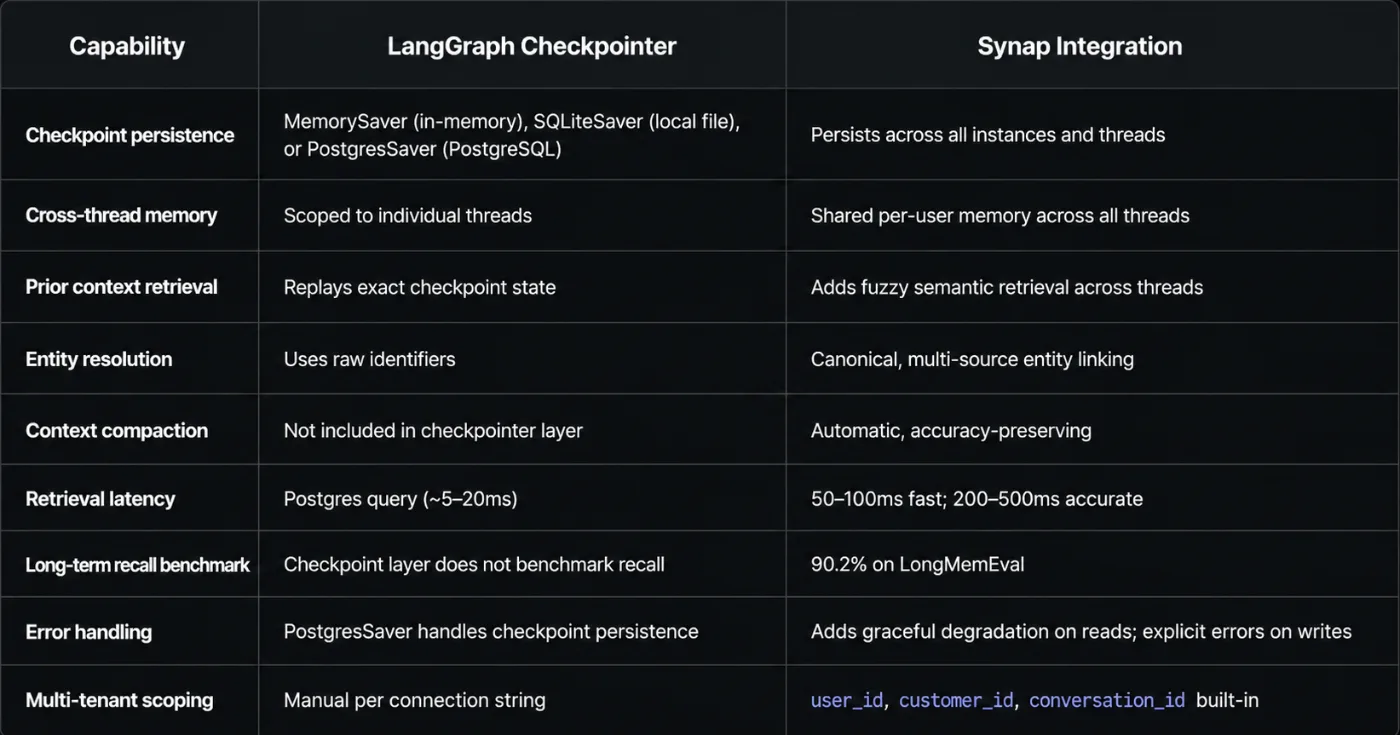
What Production Teams Gain
Cross-thread continuity. User starts in thread A, returns in thread B. Your PostgresSaver checkpointer resumes exact state. SynapStore makes thread A's context available to thread B. The agent treats every thread as one continuous conversation.
Accuracy that ships. Synap scores 92% on LongMemEval (500 questions) and 93.2% on LoCoMo (1,540 questions), benchmarks that measure whether agents recall facts across long, multi-turn conversations, reproduced on our open eval harness with gpt-5-mini as answer model and judge.
Token efficiency. Synap's Agentic Compaction keeps the working context bounded: it triggers at 3,000 tokens, 10 messages or 5 minutes idle, compresses toward a 1,500-token target while keeping the last three conversation pairs verbatim, and returns a validation score and a preserved-facts count on every pass. Re-sending the full history grows token cost quadratically with conversation length; validated compaction keeps it close to linear. At scale, that is the difference between profit and burn.
Latency that does not block. In-conversation reads come from a cache Synap pre-fetches into your own process, at an asserted P75 under 15ms; a cold retrieval targets P95 450ms, and accurate mode adds reranking and entity expansion at a higher latency. Both degrade gracefully. A failure returns empty results and a log line, not a crashed graph.
Entity resolution. "Alice from Engineering," "[email protected]," and "user_7291" resolve to one person across every thread. Synap handles this at the memory layer so your graph nodes do not have to.
Production resilience. The checkpointer handles errors silently where appropriate, raises explicit exceptions where recovery is possible. The store surfaces SynapIntegrationError on write failures so your agent knows persistence failed. Read operations never crash the graph. Everything conforms to LangGraph interfaces you already know.
How to Get Started
Three steps. No rearchitecture.
Step 1: Install.
pip install maximem-synap-langgraphStep 2: Initialize and attach.
import os
from maximem_synap import MaximemSynapSDK
from synap_langgraph import SynapCheckpointSaver, SynapStore
sdk = MaximemSynapSDK(api_key=os.getenv("SYNAP_API_KEY"))
await sdk.initialize()
checkpointer = SynapCheckpointSaver(sdk=sdk,user_id="alice",customer_id="acme",)
graph = builder.compile(checkpointer=checkpointer)
store = SynapStore(sdk=sdk,user_id="alice",customer_id="acme",)
docs = await store.asearch(("user", "alice"), query="project deadlines")
await store.aput(("user", "alice"), "preference_timezone", "Asia/Tokyo")
Step 3: Deploy. Synap handles cross-thread memory and retrieval, and your graph handles logic. For production thread state, compile with PostgresSaver as the checkpointer and pass SynapStore as the store; SynapCheckpointSaver is best-effort by design.
Full config, scoping, and error handling: https://docs.maximem.ai/integrations/langgraph. For the LangChain side (create_agent, checkpointers, stores and the Synap retriever, tools and callback handler), see How to Add Conversational Memory to a LangChain App.
Memory Is Infrastructure
LangGraph gave developers a standard for building stateful agents. Real value. The checkpointer it ships was designed to save and resume state, which it does well. Making that state intelligent across threads and sessions is a different problem.
The teams that ship production multi-agent graphs discover this around month four. They either build a memory layer on top of PostgresSaver themselves, or they plug in a system built for the problem.
This is why memory is infrastructure, not a feature.
Start building LangGraph agents that remember across threads → (https://synap.maximem.ai)
Synap pricing is usage-based. You pay for memory operations: storage, retrieval, compaction. No per-seat or per-framework surcharge. Starter plan: $19/month at launch pricing (list $49). Every new account gets about $10 in free credits to test before committing. See full pricing at https://synap.maximem.ai/pricing.
Related Articles:
Maximem's Synap & LangChain Intergration
Why AI Forgets
The Real Cost of DIY Agent Memory