Developer Guides
Your product manager walks into the engineering room with a stack of support tickets. Users are asking the same questions twice. The AI agent forgets what it discussed five minutes ago. Someone has written "agent needs memory" on the whiteboard, circled it twice.
Your engineering lead looks up. "We can build this. Give me two engineers and a quarter."
Three months later, those two engineers are four. The quarter stretches into two. The memory system works beautifully for the demo. Then you hit 500 concurrent users and everything falls apart. Meanwhile, your core product roadmap is six weeks behind, the roadmap your paying customers actually depend on.
This is the DIY memory tax. We have watched it happen at more than a dozen companies. The underestimate is almost universal. Engineering teams assume it is just a database problem. It is not.
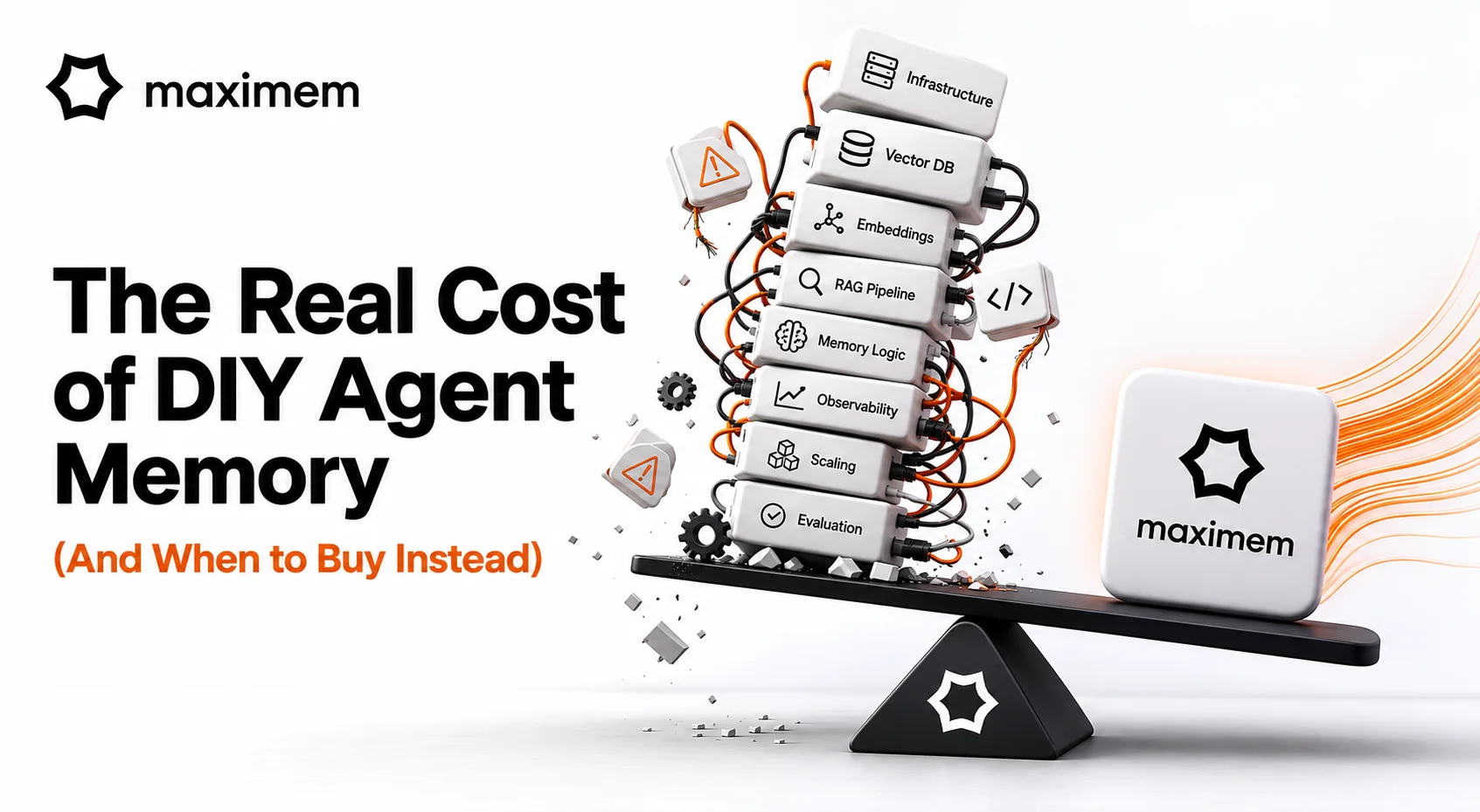
What You Actually Need to Build

Let me walk you through what a minimum viable memory system requires. This is not hypothetical. This is what needs to exist.
First: a vector database. You need somewhere to store embeddings so you can do semantic search across old conversations. Pinecone, Qdrant, Weaviate, Milvus. Pick one. The raw cost runs $100 to $1,000 monthly depending on data volume. But then comes the setup. How many dimensions for your embeddings? What is your index size? When do you rebuild it? That configuration work alone eats two weeks of engineering time.
Second: a graph database. A vector store by itself is shallow. You need Neo4j, FalkorDB, or Neptune to model relationships between entities. Without this, your agent cannot answer "what did I discuss with the person who manages the account we escalated last week?" Those multi-hop queries require a graph. Most teams discover this weakness after they have already built half a vector-only system and need to rearchitect.
Third: an embedding pipeline. The question of which model matters. OpenAI embeddings cost per token. Cohere is cheaper but behaves differently. Open-source models (Jina, E5) run on your infrastructure but require GPUs. Then text chunking. How long should chunks be? Do you overlap them? Does overlapping improve retrieval or just add noise? Teams typically spend 4 to 8 weeks tuning chunk size and overlap parameters alone. This is tedious work.
Fourth: retrieval logic. It is not just "query the database." You need approximate nearest neighbor search, metadata filtering, reranking for actual relevance, then final context assembly. Four distinct steps. Four sets of tuning parameters. Each one can tank your retrieval quality if misconfigured.
Fifth: compaction and summarization. This is where most DIY systems collapse. Old conversations need compression without losing critical context. Naive summarization is dangerous (this matters). Stanford research found that summarization reduces accuracy from 66.7% to 57.1% in a single pass. Naive approaches lose 10 to 40% of important details. Building a compaction system that preserves signal requires careful prompt engineering and often human review at the start.
Sixth: orchestration. Tying it all together. Conversation store management. Memory lifecycle policies. Garbage collection. Cross-agent context sharing if you have multiple agents. This is not a small piece of glue code. This is substantial infrastructure that requires maintenance.
That is 5 to 6 services with distinct SDKs, different authentication methods, incompatible scaling characteristics, and separate failure modes. A single bug in any layer can corrupt your entire memory system. This complexity is why understanding context windows are not a substitute for memory is crucial to your decision-making.
The Real Numbers
Let me put concrete dollar figures next to this. These numbers come from engineering teams we have spoken with.
Development costs (here is what we have observed):
Simple agent with short-term memory: $40,000 to $70,000 (roughly one engineer for 1 to 2 months of focused work)
Advanced autonomous agent with persistent memory: $80,000 to $120,000 (2 engineers over a quarter, including debugging)
Enterprise-grade multi-agent memory system: $100,000 to $200,000 and beyond (the complexity multiplies)
Infrastructure costs at scale (this is where most underestimate):
A mid-size enterprise running 200,000 queries per month against 100,000 pages of data needs $190,000 in monthly RAG infrastructure costs alone
Companies trying to extend models with data retrieval often spend $750,000 to $1,000,000 upfront and need 2 to 3 dedicated engineers just to maintain the pipeline
Engineering time (the hidden multiplier):
Minimum of 2 to 3 full-time engineers required
3 to 6 months before you have something production-grade
After launch: 20 to 40% of one engineer's time, permanently
And then the hidden costs nobody anticipates.
When you upgrade your embedding model (because the new one is better), you need to re-embed all your data. This is a data migration problem. If you have millions of conversations, this becomes painful quickly. We have seen teams spend two weeks on this alone.
Your retrieval strategy will evolve. That means schema migrations. Your old conversation format does not fit your new metadata model. This is not theoretical.
Debugging retrieval quality issues is tedious. The agent keeps surfacing a 6-month-old conversation instead of last week's context. Why? You will spend days investigating, running queries, checking your reranking logic.
In multi-agent systems, context conflicts emerge. Agent A thinks the user agreed to X. Agent B has different context saying they disagreed. Resolving these conflicts without human intervention is harder than most teams assume.
When the Economics Actually Flip
This is where we need to be honest. Build versus buy is not an emotional decision.
Building in-house makes sense if:
Your memory requirements are so specialized that no platform supports them (this is rare)
You have a dedicated ML infrastructure team with spare capacity already in place
Scale is low (fewer than 10,000 monthly interactions)
Memory is genuinely a competitive differentiator that justifies 3 to 6 months of engineering time
Buying a platform makes sense if:
Users interact more than 10 times with the same context (this is the break-even point against context stuffing)
You process more than 10,000 monthly queries
Your engineering team is small and every sprint counts toward product
You need compliance, governance, or audit trails you do not want to build yourself
Multiple agents need to share context without conflicts
The break-even math is straightforward. At approximately 10 interaction turns with 100K tokens of context, a managed memory system becomes cheaper than context stuffing. The cost differential grows as context gets longer. Run this calculation: 100 queries with context stuffing cost you roughly $50 in tokens. Memory retrieval through a managed platform costs $0.13. That is a 384-to-1 ratio. Understanding the broader agent cost stack helps frame this within your overall infrastructure expenses.
The math is clear. The real question is whether your team should spend time on memory infrastructure or on the product your paying customers actually depend on.
The Hybrid Path (Where Most Teams Actually Win)
Build versus buy does not have to be binary. We have seen this work well.
Hybrid approaches deliver results:
Use a managed memory platform for the base layer (storage, retrieval, compaction, re-embedding)
Build custom logic on top for your specific domain and use cases
Keep the hard infrastructure problems outsourced to specialists
Keep the domain-specific intelligence and business logic in-house
When evaluating any platform, check these specifics:
Latency: Does retrieval add noticeable delay to your agent's response time (measure in milliseconds)
Customization: Can you define your own memory schemas or are you locked into their model
Security: Zero-trust architecture? Encryption? Audit trails for compliance
Cost model: Per-query, per-token, flat subscription (understand what scales for you)
Integration speed: How quickly can you get a working prototype running
Your options include Synap, Mem0, Zep, Letta, or pure in-house development. Each has trade-offs worth understanding. The important thing is making the decision consciously, with actual numbers, rather than defaulting to "we will build it ourselves because we are smart engineers."
The Real Cost is Opportunity
The DIY memory tax is not just the engineering cost. It is not just the $40,000 to $120,000 or the 3 to 6 months.
It is the opportunity cost. What your team would have built instead. What features your paying customers would have received. What product problems you could have solved. What bugs you could have fixed. One team we spoke with delayed shipping a critical performance improvement by five months because half the engineering org was tied up in agent memory infrastructure that could have been purchased.
Before committing 2 to 4 engineers for two quarters to memory infrastructure, run the actual numbers. Map out each component. Figure out your actual scale. Calculate what context stuffing costs you per query today. Many teams fall into the trap of assuming one memory architecture fits all use cases. Avoid this by thinking through your specific requirements early.
The answer will likely surprise you.
Frequently Asked Questions
What are the common challenges when building a memory layer?
Six recur. Deciding what is worth keeping, merging new information into what is already stored, resolving contradictions when a user changes their mind, keeping retrieval quality up as history grows, debugging why the wrong memory came back, and making deletion propagate into summaries and embeddings.
What breaks first when a team builds memory themselves?
Contradictions. The first version stores everything and retrieves by similarity, which works until a user changes their mind and the store holds both answers with no way to choose. Almost every later problem traces back to never deciding how a newer fact beats an older one.
Why does retrieval quality fall as memory grows?
Because the number of plausible matches grows faster than the number of correct ones. At a thousand memories almost anything similar is relevant; at a million, similarity alone returns competent-looking noise, and you need recency, scope and conflict handling on top of it.
How do you debug a memory system that returns the wrong thing?
You cannot, unless it tells you what it retrieved and why. That is the single capability worth insisting on before anything else, because the failure is silent: the agent gives a confident answer built on a stale fact and nothing in the output points at memory.
When is building it yourself the right call?
When memory is the product, or when your retrieval needs are genuinely unusual. For most teams the honest question is not whether it can be built, but whether the five operations above are the thing you want your engineers spending the next two quarters on.
Get started: Synap Platform | Memory Systems Guide
Read the docs: Synap Docs | Agent Architecture Best Practices
Related posts
What Is Agentic Context Management? May 17, 2026
Skills Are the New Microservices May 17, 2026
Why AI Forgets: Why ChatGPT, Claude, and Gemini Don't Remember You Well April 5, 2026