Your AI agent forgets. Ask the same question twice, lose a constraint from three turns ago, start every session from zero. Memory is what separates an agent from a stateless API.
Three tools come up when builders discuss agent memory. Vity is a Chrome extension for personal agent memory. Synap is the enterprise-grade version with the same security model, deployed as managed infrastructure. Obsidian is a local knowledge base that some developers repurpose as agent memory by reading and writing markdown files.
Vity and Synap were built for agents. Obsidian was built for humans to write and link notes.
What Personal Agent Memory Requires
Agent memory is not storage. It is a pipeline problem. You extract facts from conversations, resolve entities across sessions, compact history without losing critical context, and retrieve the right information at the right time.
LLMs hold 128K to 1M+ tokens in a context window. That window resets when the session ends. Even within a session, stuffing everything into context gets expensive fast. Full-context prompting at scale multiplies token costs by 10x. RAG chunking retrieves documents but misses relational context between facts.
Personal agents need a dedicated memory layer. Not a vector database bolt-on. Not a folder of markdown files. Infrastructure that handles extraction, resolution, compaction, and retrieval as a coordinated system.
Obsidian as Agent Memory: What Works and What Breaks
Obsidian stores notes as markdown files in a local folder. The graph view, backlinks, and daily notes make it one of the strongest tools for personal knowledge management. Humans write notes, link ideas, and build a knowledge graph they can see and navigate. Obsidian excels at this.
Some developers repurpose Obsidian as agent memory for personal AI agents. Projects like Agent Memory, Obsidian-Memory, OpenClaw, and Hermes store atomic facts as markdown files with YAML frontmatter. Agents read and write to the vault. Git handles version control. SQLite or ripgrep handles search.
This works for personal agents and prototypes. The limitations surface when the vault grows and the agent needs to do more than store and retrieve text.
Context rot.
Large token windows alone do not solve memory. Older context degrades in relevance and accuracy over time. Your agent can hold 200K tokens and still fail to retrieve the fact that matters because it is buried under noise. Context rot is a retrieval problem, not a capacity problem.
Entity resolution.
Obsidian has no built-in entity linking. When your agent encounters "John from Acme" in one session and "[email protected]" in another, it cannot connect them to the same person without custom code. You build that code. You maintain it. When the reference patterns change, you update it.
Compaction.
Conversation history grows indefinitely in an Obsidian vault. The app is append-only by design. You can add a compaction daemon that summarizes old notes, but summarization is lossy. Stanford research found that a single summary pass drops accuracy from 66.7% to 57.1%. Each additional pass loses more. You trade recall for disk space.
Retrieval at speed.
Naive search over markdown files works for a few hundred notes. Beyond that, you need indexing. SQLite with FTS5 handles full-text search. For semantic search, you need a vector index. For relational queries, you need a graph layer. Each addition is infrastructure you build and maintain on top of the vault.
Cross-app handoff.
Your Obsidian vault is siloed to that project. What you remember in Claude does not automatically surface in ChatGPT. What you capture in Gemini does not help you in Perplexity. You build the handoff layer yourself, if you build it at all. Personal agent projects like OpenClaw and Hermes solve this for their own scope. Building universal handoff across all your AI touch points requires custom integration work.
Evaluation.
You can open a markdown file and read what the agent remembers. Useful for debugging. Useless for measuring retrieval accuracy at scale. There is no evaluation framework. You do not know if your agent remembers what it should until a user tells you it doesn't.
None of this means Obsidian is bad software. It means Obsidian was built for humans to write and link notes. Not for agents to manage context at production scale. The limitations surface when you ask a note-taking app to do the work of a memory system.
The Vity Memory Pipeline
We built Vity to solve the full memory pipeline. Not just storage. Extraction, resolution, compaction, retrieval, and evaluation as a coordinated system.
Vity lives as a Chrome extension. Install from the Chrome Web Store. Connect your AI apps. It starts capturing memories immediately. No infrastructure setup. No API keys to configure. No developer environment to maintain.
The architecture separates three concerns: short-term context for recent conversation turns, long-term memory for extracted facts and resolved entities,and cloud-synced memory that builds holistic context across all your AI touch points.
Entity Resolution
We track identity across 15 reference patterns. Names, emails, phone numbers, account IDs, session IDs, API keys. When an agent encounters "John" in one session and "[email protected]" in another, Vity links them to a single canonical entity. No custom code. No manual mapping. The resolution engine handles name variations, domain conflicts, and temporal updates automatically.
This matters because personal agents interact with users across multiple sessions and multiple identifiers. Without entity resolution, each identifier
looks like a different person. Context fragments. Retrieval misses connections.
Compaction
Conversation history grows. Vity compacts it automatically, preserving critical facts while reducing token count. Most users see 60 to 70% fewer tokens shipped to the LLM per turn after compaction kicks in.
The compaction logic is configurable and accuracy-preserving. It is not lossy summarization. Vity identifies which facts are critical, which are redundant, and which can be safely compressed. You can tune the balance between context density and retrieval completeness for your use case.
Retrieval
Two modes. Fast mode uses vector search and returns results in 50 to 100ms. Accurate mode adds graph traversal and reranking for 200 to 500ms latency.
Both modes degrade gracefully. An empty result returns without crashing your chain. A logged error lets you debug without breaking the agent. Write failures raise VityIntegrationError so your agent knows persistence missed.
Vity also supports anticipatory retrieval. The system fetches relevant memories proactively based on conversation trajectory, before the agent asks. In production, this cuts latency by 60 to 70% in cases where agents would otherwise stall waiting for a retrieval round-trip.
Cross-AI Coverage
Vity captures memories from ChatGPT, Claude, Gemini, Perplexity, and any AI app you run in Chrome. What you learn in one app surfaces in another. Your agent builds holistic context across all your AI touch points.
This is the core difference between Vity and Obsidian-based memory. Obsidian vaults are siloed per project. Vity memory is cloud-available and follows you across every AI app you use.
Cloud-available memory matters when you want to build a unified picture of yourself. Your preferences from ChatGPT, your constraints from Claude, your research from Perplexity, your drafts from Gemini. Vity assembles this into one coherent context layer. Your agents see the full picture, not just one app's slice.
Evaluation
Built-in retrieval metrics. You measure whether your agent actually remembers what it should, not just whether it stores data. Vity scores 90.2% on LongMemEval, the benchmark that tests accuracy across long, multi-turn conversations spanning multiple sessions.
This is not a vanity metric. LongMemEval measures the specific failure mode that breaks personal agents: accurate recall over distance and time. Without benchmarked evaluation, you are shipping memory and hoping it works.
Security and Encryption
Vity uses the same encryption and security infrastructure as Synap. Memory is encrypted in transit and at rest. Data ownership stays with the user. We support SOC 2, HIPAA, and GDPR compliance for users with regulatory requirements.
This is the same trust model as enterprise-grade Synap. The difference is deployment. Vity installs as a Chrome extension. Synap deploys as managed infrastructure. Same security, simpler setup.
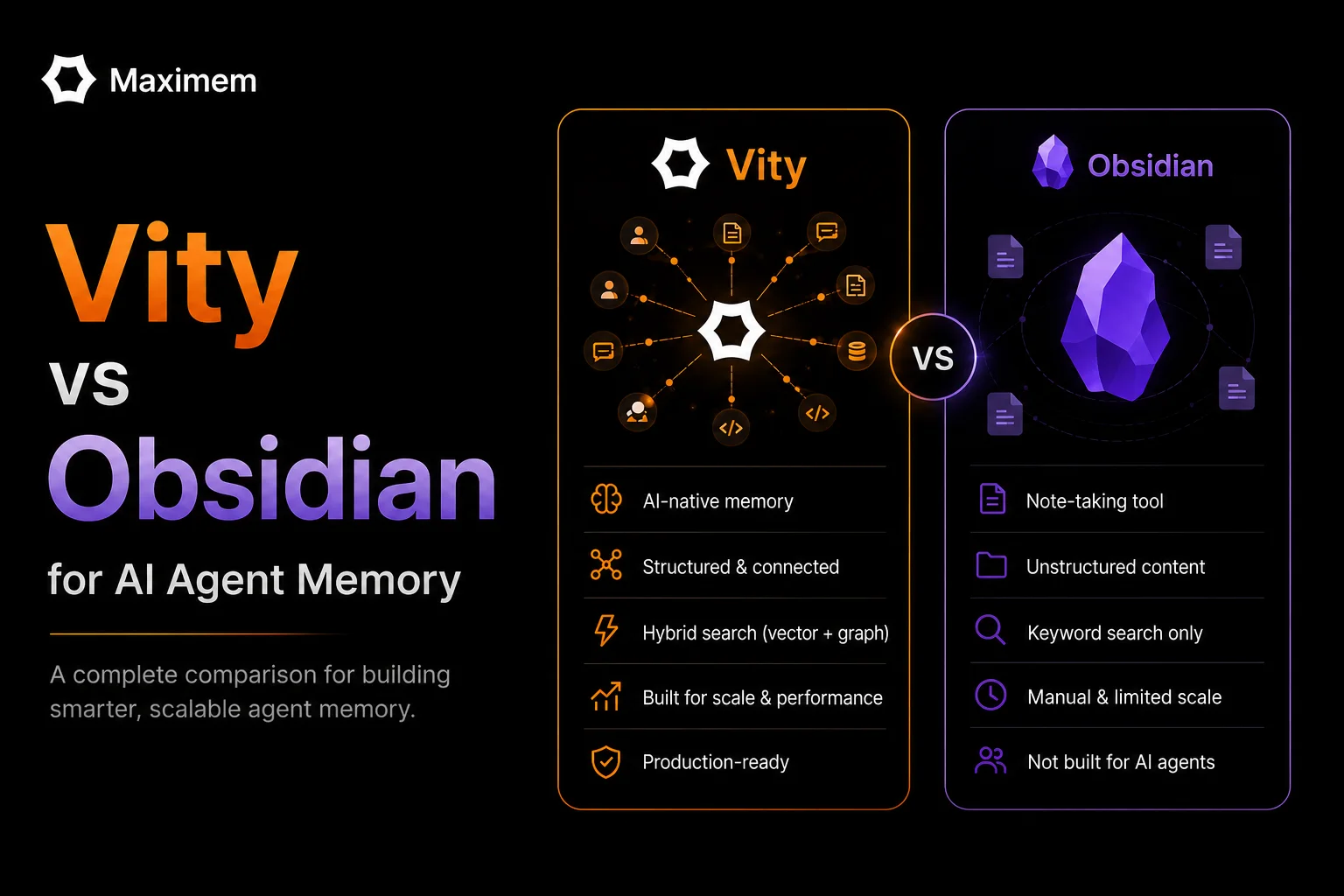
Feature Comparison
Retrieval Accuracy
Vity: 90.2% LongMemEval. Benchmarked, measured, reproducible.
Obsidian: Unbenchmarked. Retrieval quality depends on schema design and indexing approach chosen by the developer.
Retrieval Latency
Vity: 50 to 100ms fast mode. 200 to 500ms accurate mode. Anticipatory retrieval pre-fetches before the agent asks.
Obsidian: Varies. Instant for small vaults with ripgrep. Slower as the vault grows or semantic search layers are added.
Entity Resolution
Vity: Built-in. 15 reference patterns. Automatic canonical linking across sessions.
Obsidian: Not included. Custom entity resolution code required per project, maintained by the developer.
Memory Model
Vity: Short-term context, long-term memory, cloud-synced holistic context. Three coordinated layers.
Obsidian: Atomic markdown files. Append-only event logs. No layered architecture.
Compaction
Vity: Automatic, configurable, accuracy-preserving. 60 to 70% token reduction per turn.
Obsidian: Manual. Typically lossy summarization or no compaction. History grows indefinitely.
Cross-App Handoff
Vity: Built-in. Memories captured in ChatGPT surface in Claude, Gemini, Perplexity automatically.
Obsidian: Not included. Custom integration required per app. Most projects do not attempt this.
Evaluation
Vity: Built-in retrieval metrics. Benchmarked on LongMemEval.
Obsidian: Manual file inspection. No automated accuracy measurement.
Data Ownership
Vity: Cloud-hosted with E2E encryption. SOC 2, HIPAA, GDPR compliant. User owns all data.
Obsidian: Local-first. Plain markdown. No vendor dependency. Data format is fully portable.
Setup Complexity
Vity: Chrome extension install. OAuth login. Works immediately. Zero infrastructure.
Obsidian: Install Obsidian + set up vault + configure MCP server + write agent prompts + build indexing. 2 to 4 weeks to working state.
Scalability
Vity: Managed infrastructure. No capacity planning required.
Obsidian: Personal to small team. Infrastructure maintenance falls on the developer.
Integration
Vity: Chrome extension. Works with ChatGPT, Claude, Gemini, Perplexity out of the box. API available for custom integrations.
Obsidian: MCP servers, Git sync, file hooks. Community-maintained projects.
What Obsidian-Based Memory Cannot Do.
Personal agent projects built on Obsidian solve the storage problem well. They do not solve the memory pipeline problem. Here is what Vity enables that
Obsidian-based systems do not:
Anticipatory retrieval. Vity fetches relevant memories before your agent asks. The system reads conversation trajectory and pre-loads context. This cuts
latency by 60 to 70% in production. Obsidian-based systems retrieve on demand only.
Graceful degradation. When Vity cannot find a match, it returns empty results and logs an error. Your agent keeps running. When an Obsidian retrieval fails, your custom code handles it. Most projects crash or return noise.
Temporal awareness. Vity weights memories by recency and source confidence. "John" from last week ranks higher than "John" from six months ago unless the query specifies otherwise. Obsidian stores timestamps in YAML frontmatter. You build the temporal ranking logic.
Multi-tenant scoping. Vity enforces user_id, conversation_id, and customer_id at the storage layer. Obsidian vaults are single-tenant by default. Per-user scoping requires you to build folder structures, access hooks, and isolation guards.
Benchmarked accuracy. Vity scores 90.2% on LongMemEval. You know whether retrieval works before a user complains. Obsidian systems have no standard evaluation. You discover failures when users report them.
Cloud-available context. Vity memory follows you across devices and AI apps. Your context builds holistically. Obsidian vaults live on one machine unless you add sync, which introduces conflict resolution and version merge complexity.
None of these are criticisms of Obsidian. They are architectural boundaries. Obsidian was built for humans to write notes. Vity was built for agents to manage context.
Why Benchmarks Matter for Personal Agents
If your agent forgets a medical contraindication because a retrieval threshold was slightly off, that is a production incident. Not a bug. A production incident with real consequences.
Vity scores 90.2% on LongMemEval. That benchmark measures whether agents recall facts across long conversations spanning multiple sessions. It is the standard for memory retrieval evaluation.
No Obsidian-based memory project publishes LongMemEval scores. Not because the scores are low. Because there is no retrieval pipeline designed for benchmarking. Retrieval quality in Obsidian systems is a function of the schema you designed, the indexing you added, and the search strategy you chose.
You can inspect memory by opening a file, which helps with debugging. You cannot measure retrieval accuracy at scale because there is no evaluation
framework to measure it against.
Benchmarks tell you whether your memory system works before a user reports that it doesn't.
What DIY Memory on Markdown Actually Costs
Obsidian costs nothing for the software. The real cost is engineering time.
Here is what teams typically build on top of Obsidian to make it function as agent memory:
Entity resolution. Expect 2 to 4 weeks of engineering work to handle name variations, cross-session linking, and canonical identity mapping.
Then compaction. 3 to 6 weeks to build a system that compresses conversation history without dropping critical context. Most teams build lossy
summarization first, discover it drops accuracy, then rebuild.
Vector search comes next. 2 to 3 weeks to stand up a vector database, generate embeddings, and wire retrieval into the agent loop.
Cross-app handoff. 4 to 6 weeks to build integrations that capture and retrieve memories across multiple AI apps. Most DIY projects skip this entirely.
Per-user scoping. 1 to 2 weeks to isolate memory per user and per conversation in a system that was not designed for multi-tenancy.
Evaluation and observability. 2 to 4 weeks to build retrieval accuracy metrics, logging, and alerting so you know when memory fails. Ongoing maintenance. Indefinite.
That is 14 to 25 weeks of engineering time before you have something approximating a production memory system. It still will not have graph traversal, anticipatory retrieval, or benchmarked accuracy. DIY memory projects cost $40K to $120K and 6 months of depth work. Most teams realize around month 4 that they need to rearchitect half of what they built. For more on this, see The Real Cost of DIY Agent Memory.
For personal projects and prototypes, Obsidian's free price is hard to beat. For production agents serving paying users, the engineering cost of a custom memory stack on top of markdown files exceeds Vity's pricing within the first few months.
Security, Encryption, and Data Ownership
Obsidian is local-first. Your vault lives on your machine. The storage format is plain markdown. You control the encryption, the sync mechanism, and the access policies. The data format is open and portable. No vendor dependency.
Vity runs as a cloud service with end-to-end encryption. Memory is encrypted in transit and at rest. Data ownership stays with the customer. We support SOC 2, HIPAA, and GDPR compliance for users with regulatory requirements.
Vity uses the same encryption and security infrastructure as Synap. This is the same trust model we use for enterprise customers. The difference is deployment. Vity installs as a Chrome extension. Synap deploys as managed infrastructure. Same security, simpler setup.
Both approaches support data ownership. The difference is where the infrastructure responsibility lives. With Obsidian, you build and maintain the encryption, audit logging, access control, and compliance infrastructure yourself. With Vity, that is part of the service.
For users with strict data residency requirements, local-first storage has clear advantages. For users that need compliance certifications and cannot build their own encryption and audit infrastructure, a managed service with E2E encryption and SOC 2 may be the more practical path.
When Each Approach Fits
Obsidian-based agent memory fits personal tools and research projects. It works when transparency matters more than retrieval speed, when a human can inspect and edit memory directly, and when the vault is small enough that naive search covers it. It is a reasonable starting point for prototyping before committing to production infrastructure.
Vity fits personal agents serving real users. Multi-app workflows where context handoff matters. Healthcare, sales, and voice AI where retrieval accuracy directly affects outcomes. Users that would rather pay for memory infrastructure than build and maintain it.
The line between these two is not blurry. If your agent forgetting something would cause a user problem, you need a memory system with benchmarked retrieval. If your agent is a personal tool you debug by opening a file, a markdown vault works.
Memory Is Infrastructure
Personal agent builders discover the memory problem around month three. Conversation history grows. They add vector search, which misses relational context. They add entity resolution, which breaks at scale. They realize they have been building memory infrastructure from scratch on top of storage that was not designed for it.
We built Vity for that moment. Not as a layer on top of a note-taking app. As infrastructure for the full memory pipeline: extraction, resolution,
compaction, retrieval, evaluation.
Vity is a Chrome extension. Install from the Chrome Web Store. Connect your AI apps. It starts working immediately. Same encryption and security as Synap.
Cross-AI coverage out of the box. Cloud-available memory that builds holistic context across all your touch points.
The right tool is the one built for the problem.
Start building personal agents that remember across sessions (https://vity.maximem.ai)
Vity pricing is usage-based. You pay for memory operations: storage, retrieval, compaction. No per-seat or per-framework surcharge. Starter plan: $29/month. Every new account gets $25 in free credits to test before committing. Full pricing at https://vity.maximem.ai/pricing.