What Is Agentic Context Management?
Agentic context management is deciding what information your agent sees, when it sees it, and how much of your token budget goes to each piece. Prompt engineers call it context engineering. RAG vendors call it retrieval. Memory vendors call it persistent memory. Framework teams call it state management. Each describes a component of a larger system.
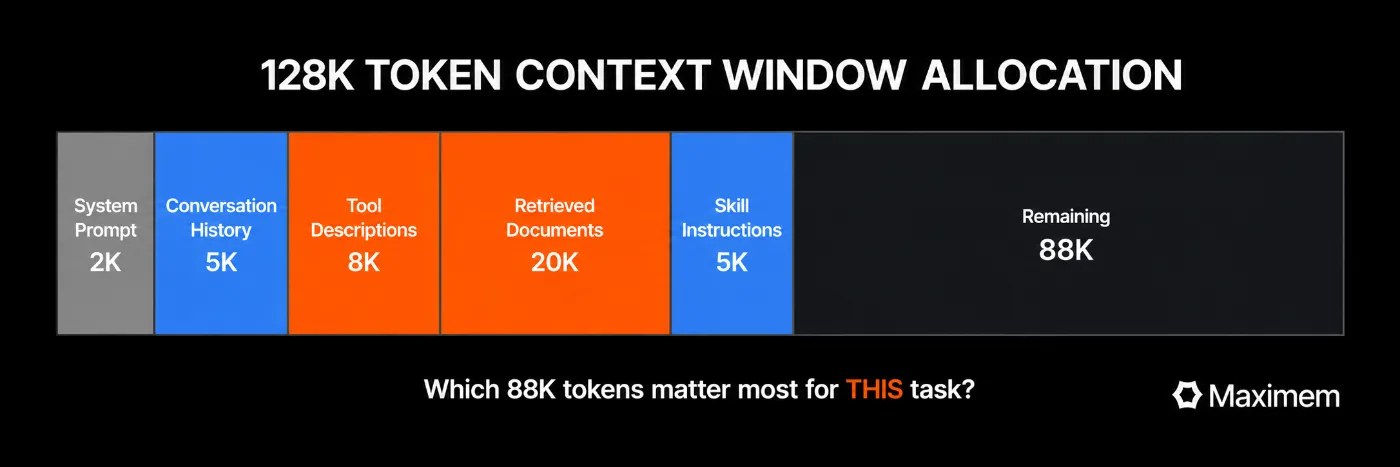
Your agent has 128K tokens. System prompt takes 2K. Conversation history takes 5K. Tool descriptions take 8K. Retrieved documents take 20K. Skill instructions take 5K. You burn 40K before the current user input arrives. The remaining 88K tokens need to carry whatever matters for this specific task. Context management is the infrastructure that handles that allocation.
Three Colliding Pressures
Persistent agents. Production agents serve the same user across weeks or months. A support agent that forgets your previous conversation is broken. You cannot rebuild context from scratch every turn.
You need a system that remembers and manages what it learns.
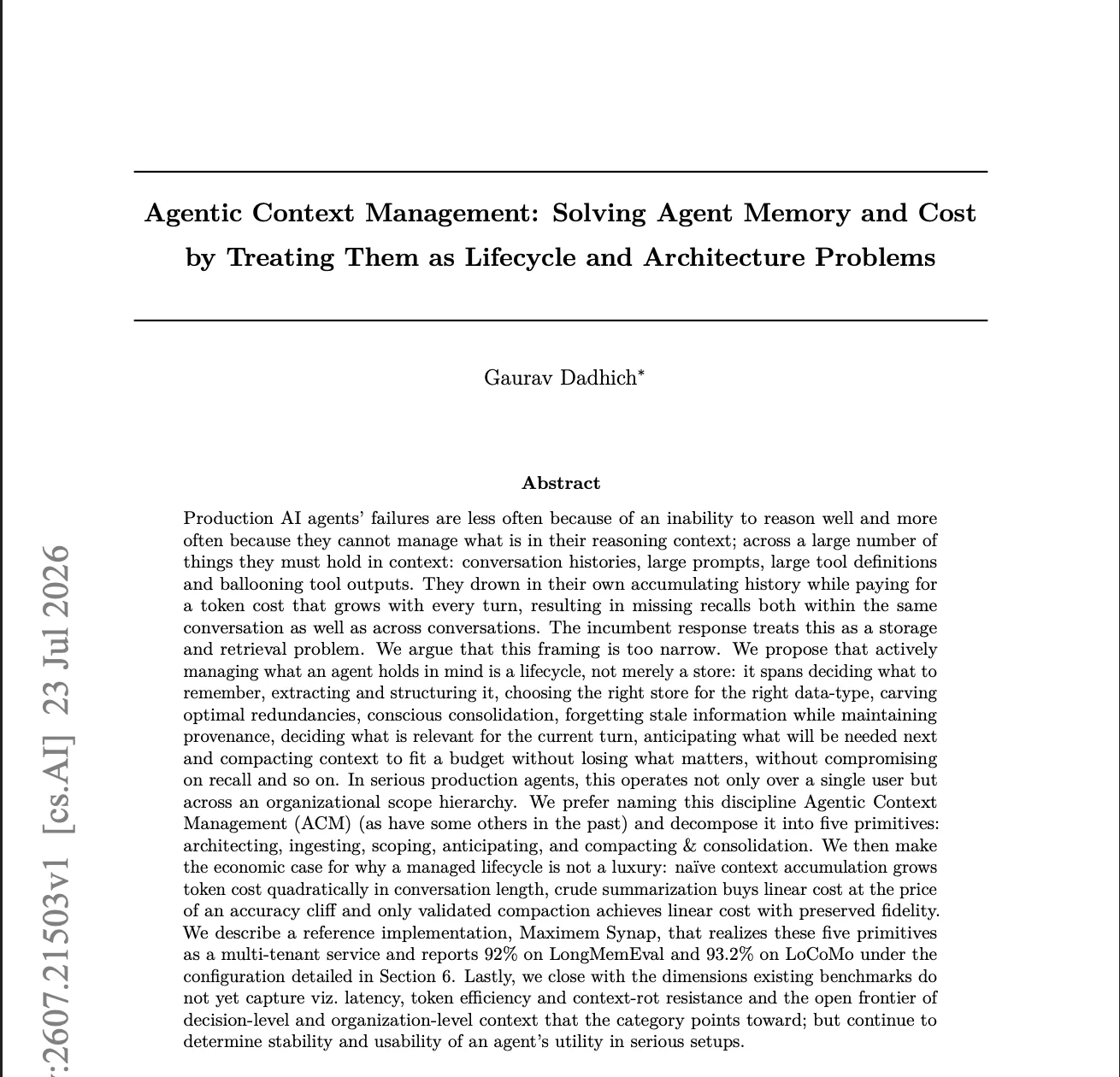
Token costs scale against you. On any single call, ten times the tokens costs roughly ten times as much. Across a conversation it is worse: an agent that keeps re-sending its growing history pays for every earlier turn again on every new one, so total token cost grows quadratically with conversation length, as our paper on Agentic Context Management shows. That math forces ruthless choices about what goes into each request.
Multi-agent alignment. When five agents handle different parts of a workflow, they need shared context. If Agent A learns something valuable, does Agent B know about it? Without shared context, agents operate in isolation and make contradictory decisions. We have seen this break entire systems.
The typical response: 2-4 engineers spend 6 months duct-taping a vector database, a graph layer, an embedding pipeline, and hand-coded retrieval logic. It works until it does not. The actual product sits idle while infrastructure gets rebuilt.
Where it Differs
Context engineering means writing good prompts and deciding what goes in a single context window. Context management makes that repeatable across dozens of production agents. One is a skill. The other is infrastructure.
RAG retrieves relevant documents. Useful, but retrieval is one function inside a system that also handles persistence, compression, staleness detection, and cross-agent sharing. RAG is a component, not the architecture, and how to give an LLM long-term memory shows what the rest of that system has to do.
Memory is the data you store. Context management decides what gets stored, what flows between agents, and what gets cut when the token budget tightens. Storage without allocation is a hard drive without an operating system.
Single-turn applications do not need context management. You need it the moment you run multi-session agents, hit token budgets hard, or coordinate multiple agents simultaneously.
Production Management
Agents retrieve only what matters instead of dumping everything into context. Stale information gets flagged before it corrupts decisions. Token budgets hold without constant manual adjustment. When
multiple agents share context, they stop duplicating work and making contradictory calls. Every retrieval decision produces an audit trail: you know what was available and what the agent actually used. Your engineering team stops maintaining this infrastructure by hand.
Build or Source
Context management is an architectural decision, not a feature you bolt on. Every production agent system needs it, either built in-house or sourced.
The math: 2-4 engineers for 6+ months building from scratch, or architecting it properly from day one. The teams that figure this out early ship faster and maintain systems at scale. Everyone else rebuilds this infrastructure while their product roadmap collects dust.
Get started: Synap Documentation