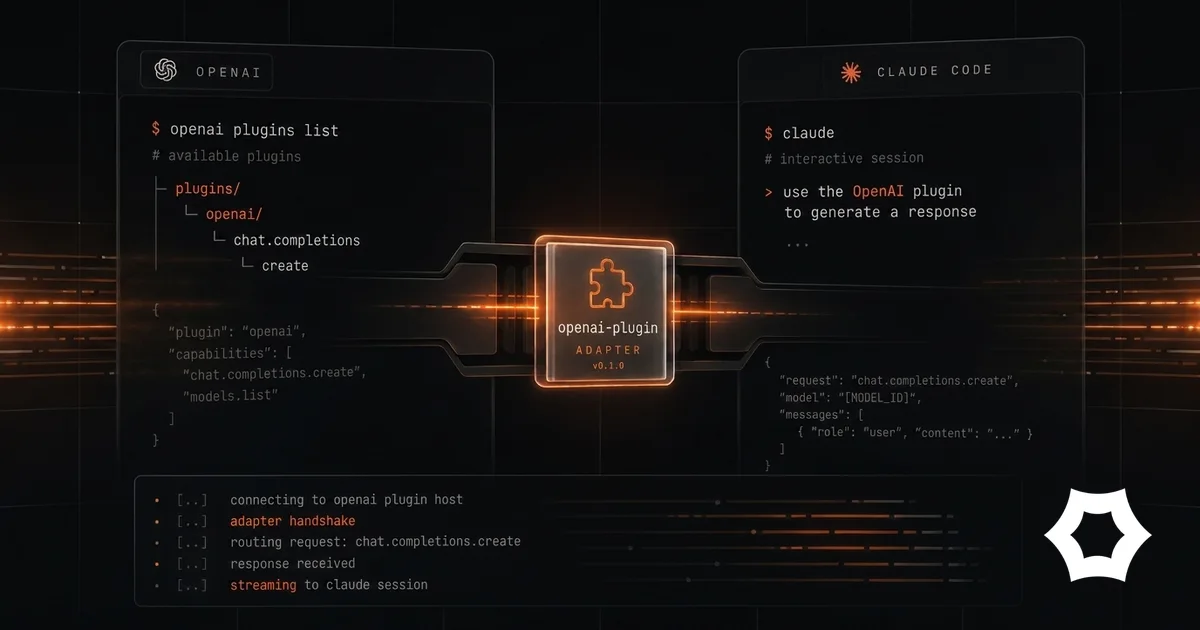
In March 2026, OpenAI open-sourced a plugin that runs Codex inside Claude Code. But it picked up steam over this last weekend as Sol 5.6 shipped. Here’s what’s happened recently and it says a lot about where the AI wars are going.
What happened
codex-plugin-cc is an official OpenAI plugin that adds Codex commands inside Claude Code, Anthropic's coding agent. /codex:review runs a full Codex review on your current work. /codex:adversarial-review makes Codex challenge your implementation, tradeoffs and hidden assumptions before you open a PR. /codex:rescue hands a stuck task to Codex when Claude is stuck and /codex:transfer moves an entire session over from Claude to Codex with the context intact. There is even a review toggle: you turn it on and Claude cannot finish a task until Codex has approved it. This plugin runs on your existing ChatGPT subscription. It already has roughly 28,000 GitHub stars.
OpenAI had announced it on its community forum on March 30. But the reason your feed is full of this week is what transpired last Friday through the weekend. Theo, of t3.gg, pointed Claude Code at GPT-5.6 Sol through a local proxy and posted the recipe, which crossed a million views. Then came the reply from OpenAIs’ Thibault Sottiaux that said, "We don't discriminate on the harness." He followed up by telling developers who are not ready to leave Claude Code, that pointing it at GPT-5.6 takes <5 minutes.
Why would OpenAI do this?!
A few obvious reasons I could think of:
Distribution: Claude Code owns one of the largest shares of the AI-developer workflow. So it is an obvious distribution win to be available where developers already work, compounded by the fact that Codex does offer a free-tier; that reduces the friction in trying it out.
Model confidence: OpenAI wants to confidently drive home the point that Codex models are now competitive to ClaudeCode. It has now been running dev-rel efforts for a while with little success (anecdotally). So this becomes a way for them to drive home the experimentation and narrative.
Positioning: While it does temporarily risk building the narrative of the supremacy of the Claude Code harness, it does give them brownie points of being open, something that they have drawn a lot of flak about in recent times (not shipping enough OSS versions).
Net net, it is an attempt to stall the run-away success on coding models that Anthropic has enjoyed for the last 8-10 months.
What are developers saying
Developers experimenting with the OpenAI plugin inside the Claude Code harness fell into four camps: early adopters rapidly testing flexible personal setups, harness-first users who see Claude Code as the best interface with a swappable model layer, fatigue-driven users who want a single polished app instead of more terminal workflows and those impressed by OpenAI’s willingness to support interoperability. The most striking reaction is that some developers say GPT-5.6 feels better inside Claude Code than inside Codex, while the broader surprise at cross-platform model support shows how rare true interoperability still is.
What does that mean for the model wars?
The model supremacy has seen seating and deseating of best-in-class several times in the last 3 years of GenAI existence. Specifically, frontier leadership in coding models has changed hands every few months and more recently as well with GLM 5.2 and Grok 4.5 claiming equivalent performance at the fraction of cost. I think it is increasingly convincing the tech community that bundled offerings with vendor lock-in isn’t the way out. People are convinced that they can pick each part of the stack independently: the model, the harness, the infra underneath, the workflow on top and so on. The correct pick at each layer changes frequently and this week made it clear that even the labs expect you to re-pick.
But the freedom to pick out from a buffet is not evenly distributed:
Indie builders can re-point Claude Code at a new model in five minutes.
For young startups, swapping parts of the stack is probably a POC + a minor org-change; lasting a week to a sprint.
For enterprises, it is governed by complex IT permissioning of tools, long-term enterprise-contracts and focus on shipping value over switching stacks frequently.
Some layers swap cleanly today, such as a model behind a harness or a harness in front of a model. Some barely swap at all: your data, your accumulated context, your workflow integrations. Knowing which is which, is now real architectural work and the cost of a wrong lock-in decision is no longer paid once. It compounds every time the frontier moves.
Where does this go hereon?
Every CIO decision now needs an interoperability line item: for each layer of the AI stack, what does it cost to leave and how fast can we adopt whatever is best next quarter. The labs just showed you the playbook as OpenAI would rather run inside Anthropic's harness than lose contact with developers. If the model companies themselves will not bet on lock-in, an enterprise betting its AI strategy on it is holding the riskiest position in the market.
The question I do not have an answer to yet: what does procurement even look like when the correct answer changes every two quarters? Whoever figures that out is going to matter more than whichever lab tops the next benchmark.