Published 27 November 2026. Every figure below was read on 26 November 2026 from the primary source named beside it: the MemT-1.0 technical report, the MemT-1.0-Pro model card, MemTensor's launch release and Meta's Self-Improving Memory post. All benchmark numbers are the authors' own measurements; none were reproduced by us.
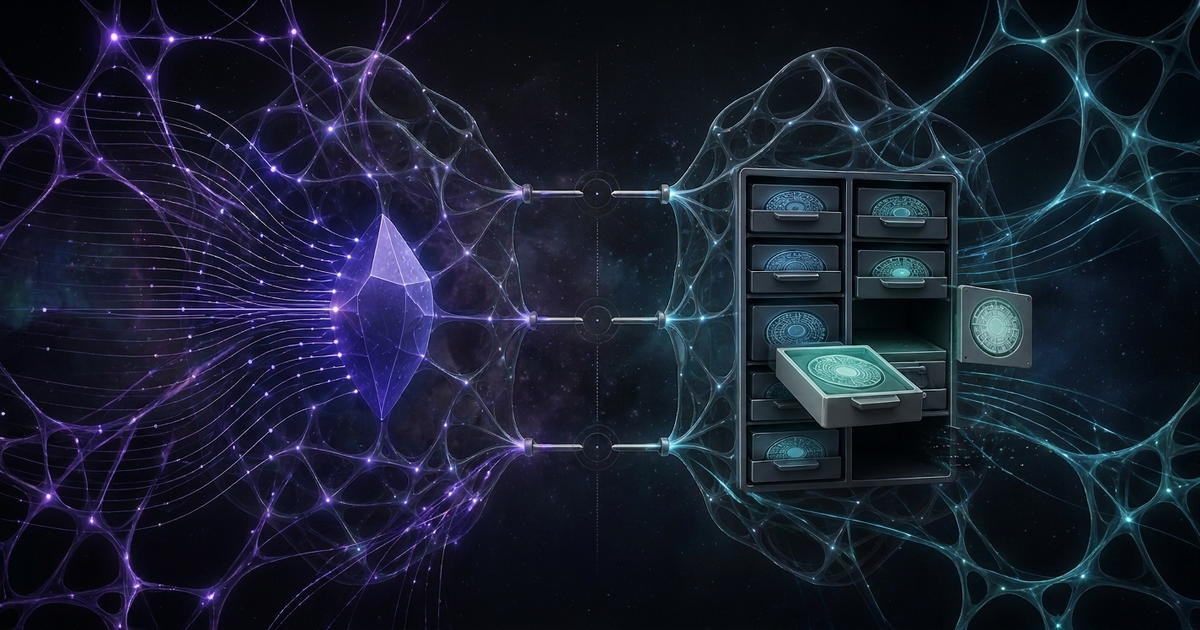
A memory-native model keeps what it learned from earlier turns inside its own computation, and an external memory layer keeps it as records outside the model that your code can read, edit, scope and delete. That one difference decides most of what follows. MemT-1.0-Pro, released by MemTensor (the team behind the MemOS memory framework) with NVIDIA on 23 November 2026, is a 554B-parameter model on Nemotron 3 Ultra that writes each conversation into a fixed-size memory state and answers later questions from that state without the original history in the prompt. On MemTensor's own comparison table, run on the same Nemotron 3 Ultra backbone, MemT-1.0-Pro averages 53.08 across 11 memory benchmarks, while MemTensor's text-based MemOS averages 72.08, Mem0 70.23 and plain dense retrieval 59.06.
So the honest answer to "memory-native model vs external memory" today is that in-model memory buys a constant-size state and a shorter prompt, and pays for it in recall precision and in control. It cannot show you what it remembers, cannot fix one wrong fact in place, cannot move to your next model, and only erases cleanly at the granularity of a whole conversation state. Memory trained into weights, the other kind of "in-model memory" in the news this month, is weaker still on every one of those operations, which is why the most useful result in Meta's paper is that it trained the skill of managing memory into the weights and left the facts in files.
What "memory inside the model" means: weights, a per-conversation state, or trained skills
The phrase covers three mechanisms that behave very differently once you need to inspect or delete something.
| Where the memory lives | Example | Written when | One user's memory is | Shared across users |
|---|---|---|---|---|
| A per-conversation state inside the model | MemT-1.0 "native memory" | At the end of every turn, by a forward pass | One state object per conversation, saved as a file | The trained memory weights are shared; the state is not |
| The model's weights | Fine-tuning, LoRA, Temp-LoRA, Doc-to-LoRA | During a training run | Mixed into parameters every user shares | Yes, everything |
| Memory skills in weights, facts in an external store | Meta's Self-Improving Memory | Skills at training time; facts at run time, as files | Files in a memory directory | The skill is shared; the files are not |
| An external memory layer | Records in a database or memory service | At run time, per turn or in the background | Records tagged with a user and tenant scope | Only what you scope to share |
MemT is the interesting case because it sits between the extremes. Its model card describes a Native Memory Block beside the backbone's attention: a Local Memory Block holds a dynamic memory matrix that evolves across turns, and a Hyper Memory Block holds trained query, key and value projections plus erase, write, forget and output gates. The technical report (section 4.3) states that during online use "backbone and hyper memory weights remain fixed and are shared across trajectories, while each trajectory maintains its own dynamic memory states." In the card's quick start, session.save_state() writes that state to a .safetensors file and a new session restores it with zero plaintext messages loaded. In plain terms, MemT's memory of you is a compressed numeric file per conversation, readable only by this model.
What MemT-1.0-Pro is, and what its numbers say
Per the model card, MemT-1.0-Pro has 554B total parameters and 59B activated, on an NVIDIA-Nemotron-3-Ultra-550B-A55B backbone, with 4.23B trainable memory parameters and a 13M dynamic memory state. Its siblings are MemT-1.0-Flash (288B total on DeepSeek-V4-Flash, 336M state) and MemT-1.0-Nano (36B total on Qwen3.6-35B-A3B, 10M state). The report says the family was trained in two stages, continued pre-training and post-training with distillation from a full-context teacher, on 34B tokens of data.
The launch numbers. MemTensor's release of 23 November 2026 reports MemT-1.0-Pro at 41.80 on BEAM-1M against 37.04 for MemT-1.0-Flash (+4.76), and 23.87 on MemoryAgentBench against 17.36 (+6.51). I checked both pairs against Table 3 of the technical report and they match. What the release headline does not carry, and the report does:
- Who measured: MemTensor, on its own models. There is no independent reproduction yet.
- BEAM-1M: ten long-history memory abilities (extraction, contradiction resolution, updating, preference following, summarisation and temporal reasoning among them), 70 questions per ability or 700 in all, each scored by averaging LLM-judged rubric scores, reported as the equal-weight macro-average of the ten abilities (appendix D.1).
- MemoryAgentBench: the "Strict" scores for the main set, reported as the equal-weight macro-average of four abilities (accurate retrieval, test-time learning, long-range understanding, selective forgetting). The report does not give a question count for this benchmark.
- Judge: gpt-4.1-mini with the OmniMemEval prompt, for LLM-judged benchmarks (section 6.1).
- Comparison: Flash and Pro use different backbones and configurations, which the release itself says. A 4.76-point gain from a bigger, different backbone says little about the memory mechanism on its own.
The comparison that matters is on one backbone. Table 3 of the report runs text memory systems and plain baselines on the same Nemotron 3 Ultra backbone that Pro is built on. These rows are all from that table, all measured by MemTensor, all with the same judge:
| Memory method, Nemotron 3 Ultra backbone | Kind | LongMemEval-S | MemoryAgentBench | BEAM-1M | Average, 11 benchmarks |
|---|---|---|---|---|---|
| MemOS (MemTensor's own) | Text memory system | 80.60 | 27.12 | 77.76 | 72.08 |
| Mem0 | Text memory system | 77.80 | 32.80 | 75.44 | 70.23 |
| OpenViking | Text memory system | 81.00 | 25.45 | 77.72 | 69.83 |
| Full context, 256K budget | Whole history in the prompt | 59.80 | 38.33 | 38.61 | 65.51 |
| Full context, model maximum | Whole history in the prompt | 59.80 | 38.57 | 45.66 | 66.17 |
| DenseRAG | Plain retrieval | 71.80 | 33.09 | 46.13 | 59.06 |
| MemT-1.0-Pro | Native memory | 33.80 | 23.87 | 41.80 | 53.08 |
| Temp-LoRA (best non-MemT parametric baseline) | Memory in weights | 13.40 | 11.98 | 32.32 | 38.08 |
In every row the answer model is the Nemotron 3 Ultra backbone, the text memory systems retrieve with BGE-M3 embeddings (MemOS at version 2.0.32), and LongMemEval-S is all 500 questions, LLM-judged. Read the table in both directions. Against other ways of putting memory into a model, MemT is clearly ahead: 15.00 points above Temp-LoRA on the average, and on BEAM-1M it even beats keeping 256K tokens of history in context (41.80 against 38.61). Against a text memory layer on the same model, it is 19.00 points behind MemOS on the average and 46.80 points behind it on LongMemEval-S. The report says so plainly: "The strongest textual memory systems still achieve substantially higher performance, particularly on LongMemEval-S and BEAM-1M," because they "provide explicit historical evidence at query time, whereas MemT-1.0 must recover the required information from its evolving states."
What native memory buys. For MemT-1.0-Nano at 128K tokens of history, the report measures about a 66x reduction in persistent storage and about a 1.86x end-to-end inference speedup against a full-context KV cache. Those are Nano figures, measured by MemTensor; the report does not give the same numbers for Pro. Under its "noise setting" (irrelevant information written into memory before general tasks), Pro shows an average change of 0.11 points below its backbone across six general benchmarks, with small gains on MMLU-Pro, GPQA Diamond and IFEval and the largest drop on LongBench v2. The state also stays the same size however long the history grows.
What it costs to run. At two bytes per parameter in BF16, 554B parameters is about 1.1 TB of weights before any state or KV cache, which makes Pro a multi-GPU server model; the GitHub README quick start serves the 36B Nano on two GPUs. Licensing is split: the model card lists the Pro weights under OpenMDW-1.1, while the repository's own code, including the SGLang serving integration, is under the PolyForm Noncommercial License 1.0.0, and the README states that commercial use of the repository software is not permitted without a separate licence.
The limit the authors name. Section 8 of the report is direct about it: the fixed-size state "imposes a capacity constraint," new information has to be folded into an existing representation, and "the resulting loss of memory fidelity remains a challenge for tasks requiring precise recall." Agent memory in production is mostly precise recall: the dosage, the account number's last four digits, the date the contract renews.
Memory trained into weights: what Meta's Self-Improving Memory actually moved
Self-Improving Memory, from Meta's RAM research group (Tong Chen, Jason Weston and six co-authors), is the other "memory in the model" result people are citing this month, and it is easy to misread. In its setup, every subtask starts with an empty context and the only thing that carries over is "a persistent memory directory that the agent reads and writes with file tools." A meta agent rewrites the prompts that tell the task agent how to use that directory, and the best prompts are then distilled into the model with LoRA (rank 64) so that a generic prompt is enough at deployment. Both agents are Kimi-K2.6.
The numbers, all measured by the Meta authors on three tasks from Continual Learning Bench (Database, Codebase and Spectrum): the optimised memory prompts reach a mean test score of 56.0 against 44.6 for the best hand-written prompts and 36.1 for the generic harness; after distillation, the model scores 43.1 with only generic prompts, against 37.6 for the same fine-tuning on its generic-prompt runs, across ten matched evaluation seeds. The post also reports that 37 of 44 generated prompt revisions failed to beat the best earlier score. The scoring is each task's own metric; the post does not describe an LLM judge or give subtask counts.
What went into the weights is the habit of writing a QUICKSTART.md, keeping an indexed registry of fixes and recording schema facts. The facts themselves stayed in files, where they could be read, edited and thrown away. That split is the strongest design signal in either paper: procedure is a good fit for weights, and state that changes is not.
The six operations: in-model memory vs an external memory layer
An agent's memory gets judged in production on operations, not on recall scores. Here is how each kind of memory handles the six that come up first in any security review or incident.
| Operation | External memory layer | Per-conversation state (MemT) | Memory in weights |
|---|---|---|---|
| Inspect what is remembered | Read the records | No readable form; you can only ask the model questions and infer | No readable form; extraction probing only |
| Correct one wrong fact | Edit or supersede that record | No targeted edit; write a correcting turn and rely on the erase and write gates, or rebuild the state from corrected source text | Retrain, or attempt unlearning |
| Erase one user (GDPR) | Delete that user's records and derived copies | Delete that user's state files, plus any source text kept for rebuilds | Not possible per user without retraining |
| Scope per tenant and user | Scope tags and filters on every read | Natural isolation per conversation; the release documents no shared tenant-level state | One adapter per tenant at best; no per-user scope |
| Carry to the next model | Records are text; re-embed and keep going | State is specific to this model's memory layers; replay the source history | Lost with the model; retrain |
| Version and roll back | Revision history per record | Whole-state snapshots via save and restore; no per-fact history | Model checkpoints only |
Inspect. An external layer stores statements you can list and read; a support engineer can answer "why does the agent think I moved to Berlin" by finding the record. A MemT state is a matrix of numbers. The report's own framing is that the model "must recover the required information from its evolving states," which means the only interface to what it remembers is the model's answer to a question, and the answer is exactly what you are trying to audit.
Correct. When a user says "that is wrong, I take 20mg, not 10mg," an external layer can supersede one record and keep the old one in history. MemT has gated erase and write operations inside each update, so a correcting turn can overwrite the old association, but there is no API to target one fact, and no way to confirm the old value is gone other than asking. If you kept the source transcript, you can correct it and rebuild the state; the release gives no rebuild cost for long histories. For weights, correction means another training run or machine unlearning, and a 2025 study of how reversible LLM unlearning is found models "can appear to forget while their original behavior is easily restored through minimal fine-tuning." Our post on agent memory versioning covers what a correctable write history needs.
Erase per user. GDPR Article 17 gives a person the right to erasure "without undue delay." MemT is more workable here than it first looks: because each conversation has its own state file, deleting a user's state files deletes that memory, and the shared weights were never updated by the user's conversation at inference time. Two caveats. First, the state is derived from personal data, so treat it as personal data; the EDPB's Opinion 28/2024 already says personal data "may still remain 'absorbed' in the parameters of the model" and that such a model is not anonymous when that data can be obtained "with means reasonably likely to be used." Second, if you keep transcripts so you can correct or migrate states later, the transcript store needs erasure too, and then you are running an external store anyway. For memory trained into shared weights, per-user erasure is not a realistic operation. The GDPR-compliant agent memory guide walks through erasure across derived copies.
Scope per tenant. Per-conversation states isolate one user from another by construction, and the report's evaluation protocol says memory "is strictly isolated across different users and histories." What I could not find in the release is a mechanism for the layered case most B2B agents need: a tenant's shared policies and product facts visible to every user in that tenant, each user's own facts visible only to them, and nothing crossing tenants. In an external layer that is a scope filter on every read. Weights have no scope at all; a fact trained into a shared model is available to every caller.
Carry to the next model. This is the operation in-model memory loses outright. A MemT state only means something to the memory layers that wrote it; even inside the family, the three models keep states of different sizes (10M, 336M and 13M). When you move from Pro to whatever ships next quarter, the memory does not come with you unless you kept the source history and replay it. Records in an external layer are text with metadata, and changing the answer model leaves them untouched. AI memory portability goes deeper on why this matters for teams that switch models every few months.
Version and roll back. MemT does give you something real here: save_state and restore mean you can snapshot a whole state and go back to it. What you cannot do is roll back one bad write while keeping everything learned after it, or see which answers relied on a fact that later changed. Weights roll back only to a whole checkpoint.
When in-model memory makes sense
Memory inside the model is a reasonable choice in a narrower set of cases than the launch release implies, and the two papers point to them clearly.
- Very long single-user histories where a constant-size state matters more than exact recall, such as a personal assistant that runs for months on hardware you control, where a growing KV cache or prompt is the real cost. The 66x storage figure (Nano, 128K history, MemTensor's measurement) is the case for it.
- Procedural experience rather than facts. MemTensor's coding experiment wrote retrieved past experience into MemT-1.0-Nano's native memory instead of the prompt. On SWE-bench Verified (500 tasks, three runs each, graded by the official SWE-bench test protocol rather than an LLM judge), average success was 69.33% with native memory, 68.87% with the same experience as text, and 66.07% with no experience, with Qwen3.6-35B-A3B as the text baseline. That is MemTensor's own measurement, on Nano after extra post-training for this use, not on Pro. The experience still came from an external experience bank, retrieved with BGE-M3; native memory replaced the prompt, not the store.
- Memory skills in weights. Meta's result says that teaching a model how to organise and read a memory store transfers into the weights. That is a gain you can take with any external store behind it.
- Research and evaluation. MemT-1.0 leads every parametric-memory method in the report's own table, which makes it the baseline to run against your own traces if you are evaluating in-model memory at all.
When an external memory store is required
An external store is required whenever one of these holds:
- You serve more than one tenant, or one tenant with users who must not see each other's memory, and you need tenant-level knowledge shared beneath per-user facts.
- You operate under GDPR, HIPAA or a security review that asks what the agent knows about a named person, and needs the answer as data, not as the model's own description.
- Facts change, and a wrong fact has to be corrected in place with a record of what it used to say.
- You expect to change the answer model within the life of a user's memory.
- Your agent's value depends on precise recall from long histories, where the same-backbone gap on LongMemEval-S (33.80 against 80.60 for MemOS) is the relevant evidence.
The two approaches also combine. A sensible near-term design keeps facts, preferences and history in an external layer with scope and provenance, and lets the model get better at using that layer, whether through Meta-style distilled memory skills or through a native-memory model that holds the gist of the current session. We covered the related retrieval question in agent memory vs RAG, and why a longer context is not a substitute for either on memory vs context windows.
How to test a memory-native claim yourself
Three tests settle most of the argument, and none of them needs access to a vendor's training data.
1. Same benchmark, same backbone, against an external memory layer. Hold the answer model constant and swap only the memory. MemTensor did this in Table 3, which is why that table is more useful than the launch comparison with Flash. Run LongMemEval-S (500 questions) and BEAM-1M, name the judge model and keep it fixed, then repeat on a sample of your own transcripts with questions you wrote before seeing any output. Report every method's score, not only the in-model group.
2. Deletion test. Write a user's history containing a few unique canary facts ("the user's locker code is 7Q4") into memory. Issue the erasure request. Then ask direct and indirect questions about the canaries in a fresh session, check that another user's memory still answers correctly, and check every place a copy might live: state files, transcripts kept for rebuilds, logs and caches. For anything trained into weights, add a relearning probe, because the unlearning study above shows suppression can come back after light fine-tuning.
3. Model-swap test. Fill memory for a set of users, record recall on a fixed question set, then move to a different answer model. Measure recall again, and measure what the move cost: hours of replay, tokens, and which source data you had to have kept. An external layer should show recall roughly tracking the new model's reading ability. An in-model memory will show zero carried state unless you replay.
Add two smaller checks while you are there: a correction test (change one fact, then ask for both the new value and what it used to be) and a tenant-leak test (ask user A's session about user B's canary).
Where Maximem Synap fits
Maximem Synap is an external memory layer, so it sits on the control side of this comparison. Every memory can be traced: where it came from, what it replaced, why it changed, and what it used to say. Memory is isolated by default across the levels that matter, your account, your tenant, the individual person and the conversation, and a read sees everything above it, never below and never sideways. Erasure is per-person removal, previewed before it runs. None of that competes with a better model; a model that has learned to use memory well is a better reader of the same records.
Frequently asked questions
Is MemT-1.0-Pro better than RAG?
No, not on MemTensor's own numbers: on the same Nemotron 3 Ultra backbone, MemT-1.0-Pro averages 53.08 across 11 memory benchmarks and DenseRAG averages 59.06, while text memory systems score higher still (MemOS 72.08, Mem0 70.23). MemT-1.0-Pro does lead every other parametric-memory method in that table, and beats a 256K-token full-context baseline on BEAM-1M (41.80 against 38.61). All figures are MemTensor's own measurements with a gpt-4.1-mini judge.
What is the difference between parametric memory and external memory for agents?
Parametric memory stores what the agent learned inside the model, either in its weights or, for memory-native models such as MemT, in a learned per-conversation state the model reads through its own attention. External memory stores it outside the model as records with a user, a tenant scope and a history. Parametric memory needs no retrieval step and keeps the prompt short; external memory can be read, corrected, scoped, deleted per user and carried to a different model.
Can a memory-native model forget one user under GDPR?
For MemT-style native memory, yes at the level of a whole conversation: each conversation has its own state file, so deleting a user's state files removes that memory, as long as you also delete any transcripts kept for rebuilding. Removing one fact while keeping the rest has no targeted operation. For facts trained into shared weights, per-user erasure is not realistic, and the EDPB's Opinion 28/2024 says such a model may not be anonymous.
Will memory-native models replace memory layers?
No, not on today's evidence: MemTensor's report shows its own text memory system 19.00 points ahead of MemT-1.0-Pro on the same backbone, and it names memory fidelity under a fixed-size state as the open problem. The more likely path is a better model reading an external layer, which is also what Meta's Self-Improving Memory points to: the skill went into the weights and the facts stayed in files.
Can I move MemT memory to another model?
No. The state is specific to the memory layers of the model that wrote it, and even the three MemT models keep states of different sizes. To move, you replay the original history into the new model, which means you need to have kept it.
What did Meta train into the weights in Self-Improving Memory?
The way to manage memory, not the memories. Kimi-K2.6 discovered better instructions for reading and writing a memory directory of files, then was fine-tuned on runs using those instructions so it behaves that way under a generic prompt. On three Continual Learning Bench tasks, that scored 43.1 against 37.6 for fine-tuning on generic runs, as measured by the Meta authors.
Sources
All retrieved 26 November 2026.
- MemTensor, MemT-1.0: Towards Memory-Native Evolution, technical report, arXiv 2610.26825 (Table 3, sections 4.3, 6, 7, 8, appendix D.1).
- MemTensor, MemT-1.0-Pro model card, Hugging Face.
- MemTensor, MemT-1.0 repository README and licence, GitHub.
- MemTensor, MemTensor Releases and Open-Sources MemT-1.0-Pro, a 554B Memory-Native Model, PR Newswire, 23 November 2026.
- Chen et al., Meta RAM, Self-Improving Memory: Meta-Optimization and Harness Distillation for Continual Learning Agents.
- European Data Protection Board, Opinion 28/2024 on certain data protection aspects related to the processing of personal data in the context of AI models, adopted 17 December 2024.
- Investigating reversibility of machine unlearning in LLMs, arXiv 2505.16831 (2025).
- GDPR Article 17, right to erasure.