Voice Agents
Building real-time voice AI agents: choosing a voice stack, managing latency and turn-taking, speech-to-text and text-to-speech, LiveKit and Pipecat.
A voice agent has roughly the length of a conversational pause to respond, and every component in the chain spends part of it. Speech recognition, the model call, any retrieval and speech synthesis all run inside that budget, so a stack that feels fine in text becomes awkward the moment a caller has to wait.
These articles cover the choices behind production voice AI: which speech and telephony providers to pair, how to keep latency down as the agent grows, and what builders running voice agents at scale actually struggle with. Framework integrations for LiveKit and Pipecat live under Agent Frameworks and are listed here as well.
Start here: Voice AI use case · Latency optimization (glossary)
Maximem Synap's Agent Memory Now Available for Pipecat
Maximem Synap's persistent agent memory now integrates with Pipecat. Per-caller persistence, entity resolution, and 92% LongMemEval, 93.2% on LoCoMo accuracy for production voice and multimodal pipelines.
Maximem Synap & LiveKit Agents Integration
Maximem Synap's persistent agent memory now integrates with LiveKit Agents. Per-caller persistence, entity resolution, and 92% LongMemEval, 93.2% on LoCoMo accuracy for production voice agents.

I Spoke to 500+ Voice AI Builders in India Over 3 Months. Here Is What I Found.
Field notes from 500+ Voice AI builders in India. An exploration of outbound dominance, the "too good" TTS problem, and why memory is the final infrastructure hurdle for production agents.
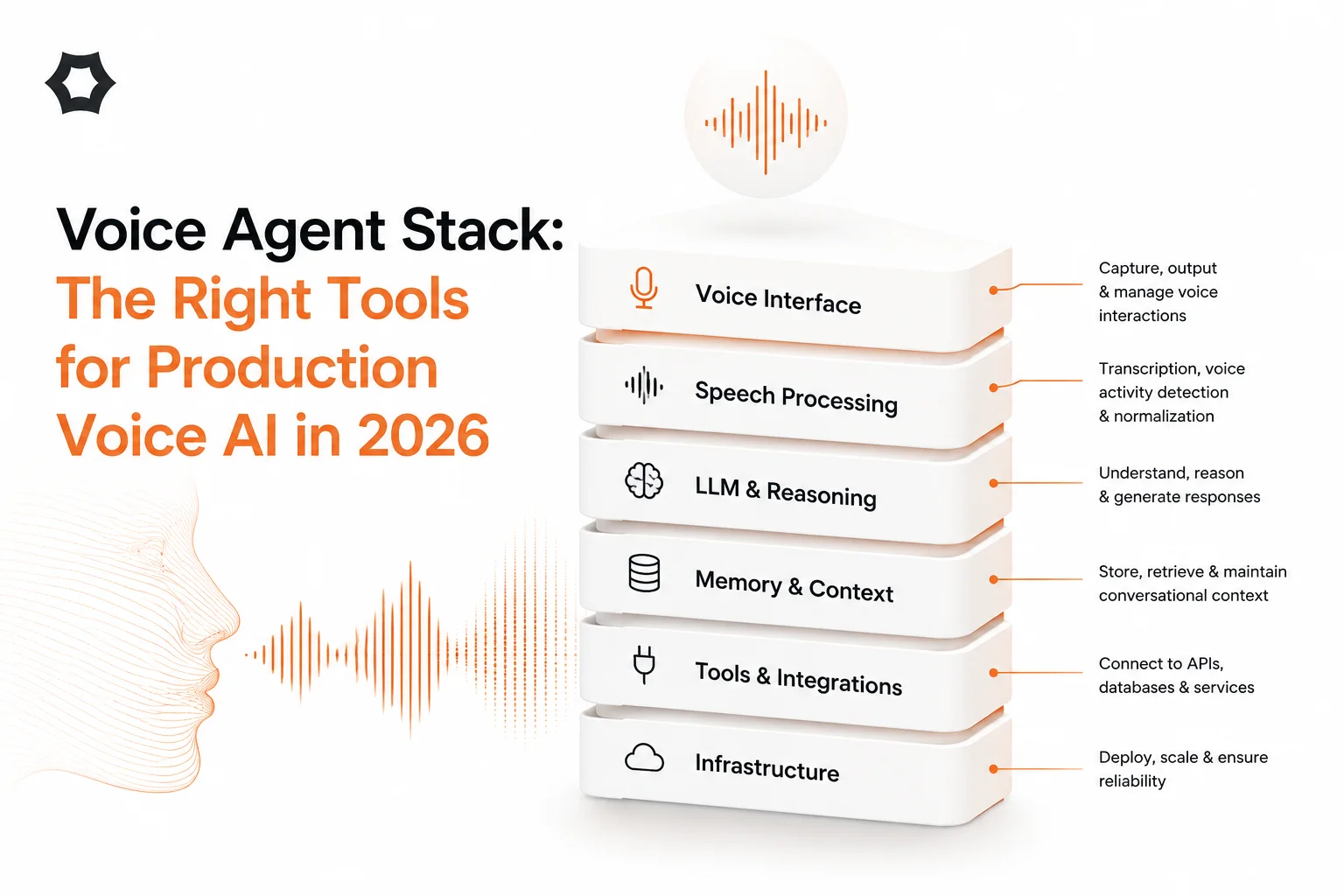
Voice Agent Stack: The Right Tools for Production Voice AI in 2026
Build production-ready voice agents with the right stack. Compare MCPs, frameworks (CrewAI, AutoGen, Swarms), APIs (Deepgram, ElevenLabs, Vapi), and learn cost-effective patterns for voice AI in 2026.