All articles · Page 2
99 articles on AI memory, agent engineering and production AI, newest first.
Mistral API Pricing 2026: Every Model per Million Tokens, Free Mode, Batch, Priority and Cost per Conversation
Mistral API pricing per million tokens as of 30 October 2026: Mistral Small 4 at $0.15 input and $0.60 output, Large 3 at $0.50 and $1.50, Large 4 at $0.70 and $2.10 after a price cut, Medium 3.5 at $1.50 and $7.50, cached input at 10%, Batch at 50% off, Priority at 1.75x, EU and US endpoints at 1.1x, what Free mode includes, and what a 40-turn conversation costs next to DeepSeek, Groq, Gemini and Claude.

What Breaks When You Build Your Own Agent Memory? Nine Failure Modes and How to Detect Each
When you build your own agent memory, the write path breaks first: unresolved contradictions, stale facts, duplicates that outvote corrections, entity confusion, deletes that miss derived copies, cross-user leakage and write cost. What each looks like in production, what causes it, and the signal that detects it, grounded in STALE, FEB-30 and HaluMem.
How Do You Test Agent Memory Before You Ship? A Test Plan You Can Run in a Week
A one-week test plan for agent memory: script multi-session histories with a known answer key, then grade the store, retrieval and outcome separately across recall, continuity, contradiction, staleness, deletion, cross-tenant leakage and hallucinated recall, with a metric and a recommended pass bar for each.

Can a Vector Database Be Agent Memory? What pgvector, pg_pinecone, Pinecone and Qdrant Give You, and What You Still Build
A vector database can be the storage and retrieval layer of agent memory, but not the memory itself. Re-checked against pgvector, pg_pinecone, Pinecone and Qdrant documentation on 2 November 2026: what each gives you for filtering, tenants, hybrid search and deletes, what Pinecone's new Postgres extension fixes and what it leaves out, the five write-path operations none of them performs, and when a vector database alone is the right answer.

Agent Memory vs RAG: When Do You Use Which?
Use RAG for shared knowledge that changes by new versions and agent memory for per-person facts that get corrected. Plain RAG over raw chat history matched or beat memory systems in six of seven benchmark settings in October 2026, and retrieving the raw history alongside memory cut the losses memory adds.

Groq API Pricing 2026: Every GroqCloud Model per Million Tokens, Free Tier Limits, Batch and Cost per Conversation
Groq API pricing per million tokens as of 27 October 2026: GPT-OSS 120B at $0.15 input and $0.60 output, GPT-OSS 20B at $0.075 and $0.30, Qwen 3.8 27B at $0.80 and $4.00, cached input at half price, Batch at 50% off, free and Developer plan limits, the Llama models that moved to enterprise, and what a 40-turn conversation costs next to DeepSeek, Gemini and Claude.

DeepSeek API Pricing 2026: deepseek-flash and V4 Pro per Million Tokens, Peak vs Off-Peak, and Cost per Conversation
DeepSeek API pricing per million tokens as of 27 October 2026: deepseek-flash from $0.15 input and $0.60 output off-peak, V4 Pro from $0.66 and $1.98, cache hits from $0.003, the weekday peak hours that double every rate, and what a 40-turn conversation costs next to Claude and Gemini.

Gemini API Pricing 2026: Every Model per Million Tokens, and the Rates That Double in December and January
Gemini API pricing per million tokens for every current model as of 27 October 2026, from Flash-Lite at $0.25 to Gemini 4 Argon at $2 input, the December and January rises that double Argon and 3.8 Flash, and what a 40-turn conversation costs next to Claude and OpenAI.

Prompt Caching in Coding Agents: How Claude Code, Codex CLI, OpenCode and Pi Keep the Prefix Stable
A coding agent sends its entire context again on every request, so prompt caching decides most of what a session costs: a 60-request session on Claude Sonnet 5.5 costs $12.99 with no caching and $1.31 when every request hits the cache.

TencentDB Agent Memory, Read From the Source: It Needs a Second LLM and Searches by Keyword by Default
The guides and news pages that rank for TencentDB Agent Memory repeat three claims its source code does not support: that it builds memory without any model API, that it runs hybrid vector search out of the box, and that no conversation data leaves the machine.

Local Embedding Models in 2026: Which to Run, What Hardware They Need, and What They Cost
A local embedding model turns your text into vectors on hardware you control, so no document or query leaves your machine to get embedded.

Context Language Models: What the UW and Meta Paper Changes for Agent Builders, and What It Leaves to Memory
A Context Language Model is an existing model that rewrites its own context like a file. It manages working context inside a task better than summarisation, with less compute, and throws that context away when the task ends.
What Is an Agent Harness? Harness vs Model vs Agent, and Why the Harness Sets the Bill
An agent harness is the software that turns a stateless model into an agent: the loop, tools, context, compaction and permissions around it. Same-model studies from October 2026 show the harness barely moves the score on short coding tasks but sets the bill, with up to 3x cost per task from preamble size and a 13x gap in one practitioner's single-task anecdote that he puts down to prompt caching.
How to Add Conversational Memory to a LangChain App (2026 Guide)
To add conversational memory to a LangChain app today, pass a checkpointer to create_agent and reuse one thread_id per conversation; to remember a person across conversations, add a LangGraph store or plug in Maximem Synap through the maximem-synap-langchain package.
Short-Term vs Long-Term Memory in LLMs, and What "Context Memory" Actually Means
Short-term memory in an LLM is whatever sits in the context window on the current call: the system prompt, the recent conversation, tool results and any retrieved text, all re-sent by the application on every request and gone when the request ends.
LLM Context Window Sizes in 2026: Every Model's Limit, the Long-Context Price Cliffs, GPT-4o's 128K, and What Happens When a Chat Runs Out
Every major LLM's context window and max output as of 28 October 2026, from GPT-6's 1,050,000 tokens to Grok 4.7's 500,000, the long-context price cliffs at 100K (Claude Haiku 5.5), 200K (Gemini 3.1 Pro, Grok 4.7) and 272K (OpenAI), GPT-4o's 128,000-token window and 16,384-token output limit, and what each API and chat app does when you run out.
Best Embedding Models in 2026: Open-Source Picks, Semantic Search, and How to Choose for RAG
As of 27 October 2026, the best open-source embedding model for most teams is still Qwen3-Embedding (Apache 2.0, 32K tokens, 5th on MTEB English v2 and 4th on Multilingual v2), and none of October's releases, including EmbeddingGemma 2, Cohere Embed 5 and Nemotron 3.5 Embed, displaces it.
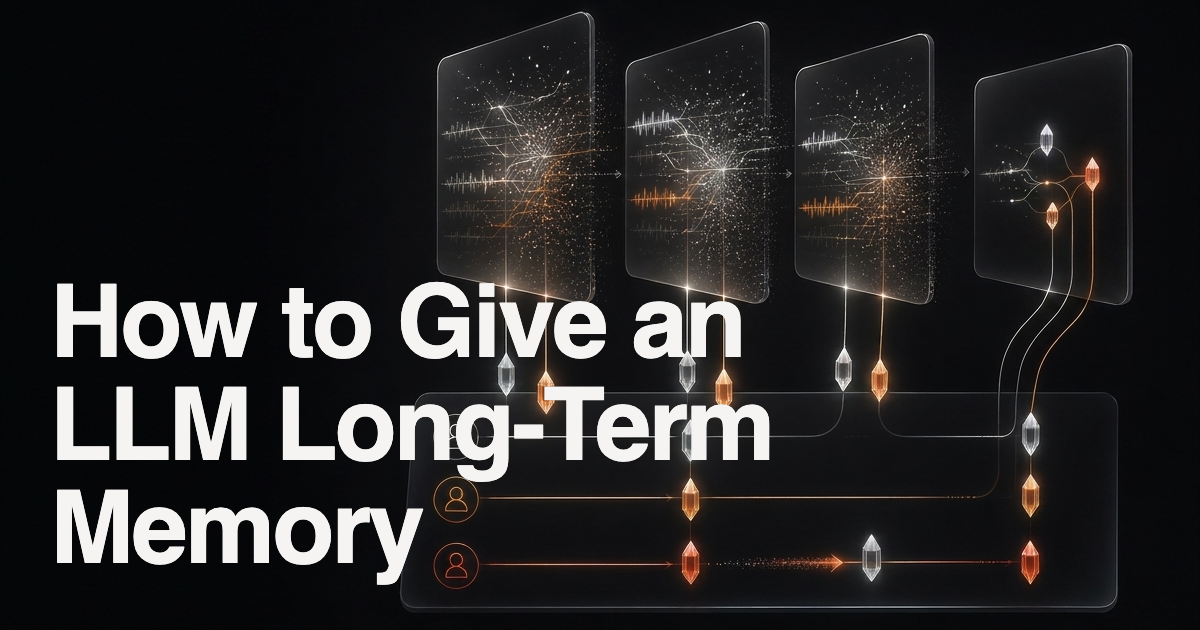
How to Give an LLM Long-Term Memory, and Why RAG Alone Is Not It
You give an LLM long-term memory by adding a layer outside the model that decides what is worth keeping from each conversation, stores it against the right person, updates it when a fact changes, and puts only the relevant slice back into the prompt on the next call.
What Is RAG? How Retrieval-Augmented Generation Works, and Where It Stops
RAG, short for retrieval-augmented generation, is a technique that lets a large language model answer from information it was never trained on: when a question arrives, the application searches a knowledge source for the most relevant passages, places them in the prompt next to the question, and the model writes its answer from that material.
Knowledge Graph vs Vector Search for Agent Memory: When to Add a Graph, and Why Time Matters
Knowledge graph agent memory stores what an agent learns as entities and dated relationships, while vector search finds past statements that mean something close to the question. When to add a graph, what it costs per write, and how two clocks (when a fact was true, when the memory learned it) let an agent answer "now", "as of" and "what did we know then" for users and for the business alike.
What Is a Graph Database, and When Should You Use One?
A graph database stores data as nodes and relationships and answers questions by following those relationships instead of joining tables; use one when your main questions are about paths across connected data, and keep a relational database for records and reporting.
How to Reduce LLM Token Costs in Long Conversations: What Caching Saves, and Where It Stops
A long conversation costs far more than its number of turns suggests, because every request carries the system prompt and the entire history again, so total input grows with the square of the number of turns.
Claude API Pricing 2026: Every Model per Million Tokens, Cache Read and Write Prices, and Cost per Conversation
Every Claude model's API price per million tokens on one table, as of 27 October 2026, with cache write and read prices, Haiku 5.5's 100K-token tier, the new API credits on Max and Team, and what a 40-turn conversation actually costs.
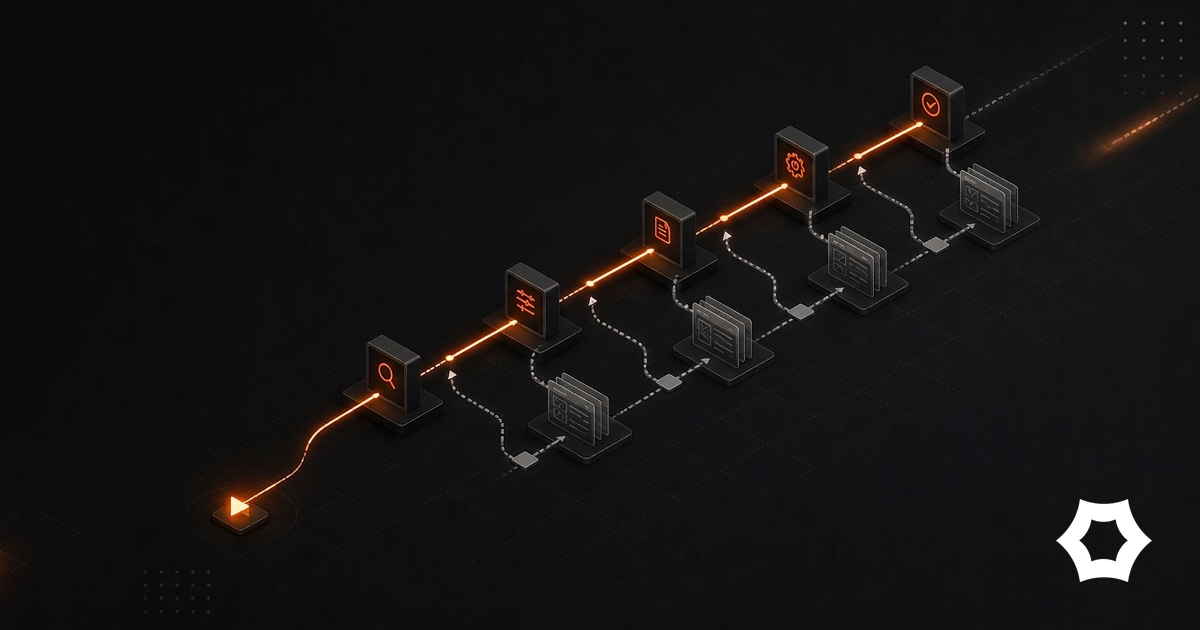
What is WebMCP? When and How to Use WebMCP in a Browser Agent?
The decision is per step, not per site: a page can expose a clean search tool and leave its account settings as ordinary DOM controls, so an agent that picks one mode per domain gets the worst of both.